Caesar Kimmel Character Profile Page
Born in 1930 (same year as Buddy Jacobson) Caesar Kimmel was the son of notorious underworld figure Manny Kimmel and father of horse trainer John Kimmel. He was born into contradiction. Raised in the long shadow of one of America’s most quietly powerful underworld financiers, he chose a path that placed him not in back rooms of rackets, but on the backstretch of racetracks—where sweat, loyalty, and survival defined a man more than his name.
A contemporary and associate of Buddy Jacobson, Ceasar operated in the same orbit of New York racing culture during its most volatile decades. While others chased quick scores, Ceasar built influence through relationships—with trainers, grooms, jockeys, and owners who depended on the fragile economics of the sport. His role in the early growth and advocacy efforts tied to the Horsemen’s Benevolent and Protective Association (HBPA) made him an important, if understated, figure in the fight for pensions, protections, and dignity for backstretch workers.
Where Buddy Jacobson often embodied instinct and hustle, Caesar represented calculation and restraint. He understood systems—how money flowed, how pressure was applied, and how to navigate power without appearing to wield it. He was not loud, not flashy, and rarely the center of attention. But when decisions were made behind closed doors, Caesar was often closer to them than most realized.


Personality & Traits
- Measured and Observant: Speaks less than he listens; processes before acting
- Loyal but Pragmatic: Values relationships, but never blindly
- Financially Literate: Grew up understanding money, leverage, and risk
- Dual-Natured: Balances legitimacy with an inherited awareness of the underworld
Ceasar and Buddy shared mutual respect rooted in the racetrack trenches. Buddy brought raw instinct and boldness; Ceasar brought structure and perspective. Their dynamic reflects two sides of the same world—one driven by action, the other by strategy. Ceasar often served as a quiet counterbalance, someone who could read consequences before they unfolded.
What emerges from the Kimmel family account is not just a parallel story to Buddy Jacobson’s world, but a direct lineage of influence that helps explain how the old-school horsemanship of Hirsch Jacobs evolved into the street-smart, instinct-driven methods of Buddy Jacobson—and ultimately into the modern, more analytical approach of the Kimmels.
At the foundation sits Emmanuel Kimmel, known as Manny, a numbers man in the truest sense. In the 1930s and 1940s, while Hirsch Jacobs was refining a philosophy of hands-on care, intuition, and respect for the horse, Manny was operating in a different but adjacent ecosystem—bookmaking at Saratoga, managing risk, reading patterns, and understanding probability before it was formalized. His ability to “make a book” was not far removed from a trainer’s ability to read a horse. Both required instinct, discipline, and a tolerance for uncertainty.
Manny’s son, Caesar Kimmel, grew up inside that world—literally driving his father to the gates at Saratoga as a teenager. By the time he returned from the Marines after World War II, he carried both that street education and a broader ambition. Manny handed him the opportunity that became Kinney Parking, a business born from risk, leverage, and opportunism—the same traits that defined many racetrack operators of the era. That company would eventually evolve into Warner Communications, linking the Kimmel name not only to racing but to entertainment itself. Kismet: Producer Jay Shapiro met David Crosby at his Aunt's Italian restaurant in Chicagoland in the 1990's. David happened to have been a product of Warner Brothers!
While Caesar expanded into media, music, and film, he never left the Turf. He owned and bred horses, maintained a Kentucky farm, and operated within the same racing circles that had been shaped by Hirsch Jacobs and his contemporaries. This is where the connective tissue forms: Jacobs represented disciplined horsemanship; Caesar represented capital and expansion; and between those poles emerged figures like Buddy Jacobson.
Buddy Jacobson absorbed the old guard’s lessons but adapted them to a harsher, faster, more transactional world. Where Hirsch Jacobs was methodical and almost clinical in his care, Buddy added edge—street awareness, deal-making, and a willingness to operate in gray areas. He was part horseman, part operator. That evolution reflects the broader shift in racing from craft to commerce.
By the next generation, John Kimmel brings the story full circle. Trained as a veterinarian, he reintroduces the scientific precision that echoes Hirsch Jacobs’ diagnostic instincts, but with modern tools. His philosophy—preferring smaller, hands-on stables over industrial operations—mirrors Jacobs almost directly. At the same time, his ability to identify value in young horses and navigate sales markets reflects the financial acumen inherited from Manny and Caesar.
In that sense, the arc is clear:
Hirsch Jacobs establishes the gold standard of horsemanship.
Buddy Jacobson translates it into a tougher, more opportunistic era.
The Kimmels integrate both worlds—instinct and analytics, tradition and scale.
It is not a coincidence. These were overlapping circles—Saratoga, Aqueduct, Belmont, Hialeah—where bookmakers, trainers, owners, and entrepreneurs all intersected. The Kimmel story does not sit outside the Buddy Jacobson universe; it runs alongside it, reinforcing the idea that American racing was built as much on relationships and intuition as on horses themselves.
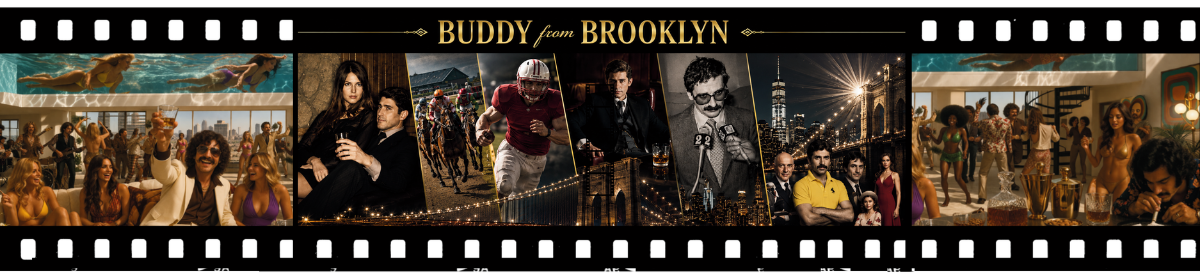
This lineage is exactly the kind of connective narrative that strengthens My Buddy from Brooklyn: it shows that Buddy wasn’t an outlier—he was part of an evolving ecosystem shaped by men like Hirsch Jacobs and families like the Kimmels, where instinct, risk, and ambition passed from one generation to the next.