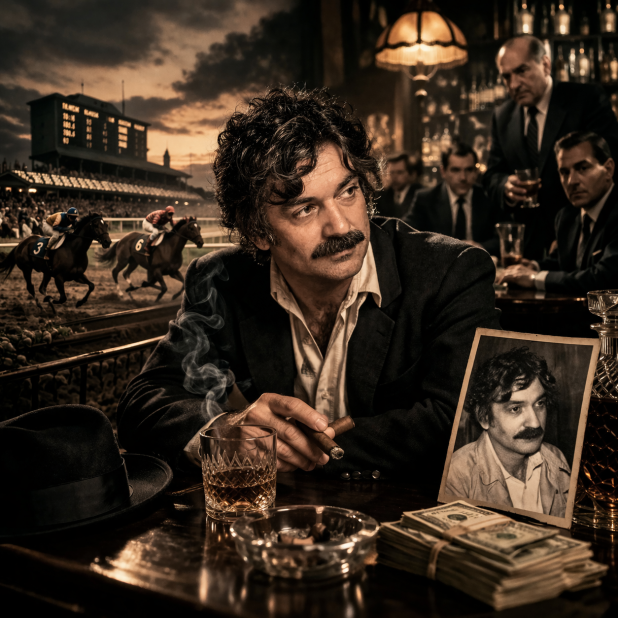
Compelling Potential Movie Scenes
From Brooklyn racetracks and Manhattan penthouses to Studio 54, organized crime, murder, courtroom spectacle and a remarkable escape, the life of Buddy Jacobson offers an extraordinary collection of cinematic possibilities.
Act I: Brooklyn Beginnings
1. “He’s My Little Buddy”
Brooklyn, 1930. Florence Jacobson holds her newborn son beside a tenement window as elevated trains rattle through the distance. She looks into his eyes and quietly gives Howard Jacobson the name that will follow him from the backstretch to the front pages: “He’s my little Buddy.”
2. The Boy Who Chose the Racetrack
Eleven-year-old Buddy leaves school and reports to work for his uncle, horse trainer Eugene Jacobs. Surrounded by powerful thoroughbreds, hard-bitten grooms and clouds of morning steam, Buddy discovers a world where instinct matters more than education and winning can change a man’s life overnight.
3. The Triple Dead Heat
Three horses charge toward the finish line so evenly that the crowd cannot tell which one has won. Officials study the photograph while bettors shout and argue below. Young Buddy watches from the rail, fascinated by the razor-thin boundary between victory, defeat and history.
4. The Hialeah Deception
Buddy tells his family he is traveling to Florida to study. In reality, he arrives at glamorous Hialeah Park to race horses beneath royal palms and pastel skies. The scene can contrast his family’s expectations with the intoxicating freedom of the track as Buddy secretly begins building his own future.
Act II: King of the Racetrack
5. The License
In 1951, Buddy receives his professional trainer’s license. He studies the document for only a moment before folding it into his jacket and returning to the barn. The understated scene signals that Buddy does not intend merely to participate in horse racing—he intends to conquer it.
6. The Brooklyn Clockmaker
Before dawn at Aqueduct, Buddy stands alone with a stopwatch, studying every stride of a horse moving through the fog. He notices a nearly invisible weakness that everyone else misses. Later that afternoon, his tactical decision produces another unexpected victory.
7. America’s Leading Trainer
A sweeping montage follows Buddy through Aqueduct, Belmont, Saratoga, Bowie, Hialeah, Keeneland and Churchill Downs. Horses thunder across finish lines, owners shake his hand and newspapers record his rise as one of the most successful trainers in the country.
8. The Magazine Cover
Buddy sees himself featured nationally as the face of American horse racing. Family members celebrate, rivals study the story suspiciously and Buddy acts as though the recognition was inevitable. The triumph can be intercut with the first signs that powerful racing interests are becoming uncomfortable with his influence.
9. The Pension Strike
As president of the horsemen’s organization, Buddy confronts racing executives over pensions and working conditions. Horses remain in their barns, the grandstands grow restless and competing factions try to force Buddy to surrender. He refuses, turning a labor dispute into a personal war.
10. Buddy Versus the Racing Establishment
Buddy is denied stall space and retaliates with a massive lawsuit against the New York Racing Association. In a tense conference-room scene, racing officials warn him that some institutions are too powerful to fight. Buddy lights a cigarette, studies the men across the table and tells them they have underestimated a kid from Brooklyn.
Act III: Money, Models and Manhattan
11. Negotiating with the Mob
Buddy enters the back room of an Italian restaurant to negotiate the purchase of a valuable Manhattan property. The sellers are not ordinary businessmen. Espresso is poured, veiled threats are exchanged and every man at the table understands that the paperwork is only one part of the transaction.
12. The East 84th Street Empire
Buddy walks through a deteriorating Upper East Side building and imagines what it could become. A transformation montage follows: construction crews, mirrored walls, fashionable tenants, ringing telephones, cash-filled envelopes and the creation of a glamorous penthouse above the city.
13. The Penthouse Window
Models gather inside Buddy’s East 84th Street penthouse, distinguished by its large round window overlooking Manhattan. Champagne flows while Buddy watches the street below like a man surveying his kingdom. The luxurious setting becomes a recurring visual symbol—first of success, later of danger and isolation.
14. The Norway Inn
Buddy and Tony DeRosa purchase a quiet ski lodge and reinvent it as a wild singles resort. Snow falls outside while the interior explodes with live music, dancing, alcohol, romantic entanglements and colorful characters from New York’s nightlife scene.
15. Buddy Meets Melanie
Buddy first sees Melanie Cain in a room crowded with beautiful people, yet the noise seems to disappear when their eyes meet. Their attraction is immediate, but the scene should also suggest that Melanie is ambitious, observant and far more formidable than Buddy initially realizes.
16. Building My Fair Lady
Buddy and Melanie launch their own modeling agency. Auditions fill the room with aspiring models, photographers and fashion-industry personalities. Buddy handles money and real estate while Melanie transforms raw discoveries into polished Manhattan professionals.
17. Dawn Eve Arrives from Minneapolis
In 1974, Buddy and Melanie scout young Minneapolis model Dawn Eve and bring her to New York. She steps from a cab with her luggage and looks up at the East 84th Street building, unaware that she is entering a world of fashion, wealth, danger and history.
18. The Models’ Penthouse
A lively sequence follows the models as they prepare for castings, trade clothes, practice runway walks and navigate the temptations of 1970s New York. Beneath the glamour, whispered conversations reveal that Buddy’s business dealings and personal relationships are becoming increasingly complicated.
19. Model of the Year
Melanie is photographed by Francesco Scavullo and honored as Model of the Year. Flashbulbs illuminate her triumph while Buddy stands nearby, proud but increasingly aware that she has become a star with an identity and power entirely her own.
Act IV: Disco, Cocaine and Organized Crime
20. A Night at Studio 54
A limousine pulls through a wall of photographers and hopeful clubgoers. Inside Studio 54, celebrities, socialites, models, athletes and underworld figures move beneath theatrical lights. Buddy enters as a recognized man, equally comfortable among racing royalty, fashion stars and dangerous associates.
21. The Bathroom Transaction
While dancers celebrate only feet away, a quiet conversation unfolds inside a mirrored nightclub bathroom. A package changes hands, a debt is mentioned and Buddy realizes that the people surrounding him are operating on a scale far beyond ordinary nightlife excess.
22. The Horse-Racing Underworld
Buddy attends a private gathering where trainers, bookmakers, businessmen and organized-crime figures discuss horses as though they were pieces on a chessboard. The scene suggests that important races may involve hidden alliances, old favors and consequences invisible to the cheering public.
23. The Hoffa Conversation
News of Jimmy Hoffa’s disappearance reaches a group of men connected to racing, unions and the underworld. Names and locations are discussed carefully, followed by a sudden silence when Buddy enters. The scene raises questions without revealing more than the story can responsibly prove.
24. The $200 Million Shadow
Brief scenes of ships, warehouses, coded telephone calls and federal surveillance gradually introduce a cocaine operation reportedly valued at approximately $200 million. Buddy may be behind bars by the time the case explodes, but familiar names and relationships connect the bust to the larger world he once inhabited.
25. Dinner with Sonny
Buddy meets veteran mob figure Sonny Franzese in a restaurant where every waiter appears to know who is important. The conversation is cordial, humorous and almost fatherly, yet the scene never allows the audience to forget the violence surrounding both men’s worlds.
Act V: Love, Jealousy and Murder
26. Jack Tupper Moves In
Jack Tupper arrives at Buddy’s East 84th Street building carrying boxes from Queens. He exchanges a glance with Melanie that Buddy immediately notices. What appears to be an ordinary introduction begins the emotional triangle that will eventually consume all three lives.
27. Dinner Across the Street
Buddy watches from his window as Melanie and Jack enter Nicola’s Italian restaurant across the street. The sounds of the city fade as jealousy overtakes him. He remains motionless in the circular window, looking less like a wealthy landlord than a man trapped inside his own obsession.
28. Apartment Shopping
On the morning of August 6, 1978, Melanie searches for an apartment and imagines a new life. Her optimistic morning can be intercut with Buddy’s increasingly ominous movements elsewhere in the city, creating a slow-building sense that several lives are approaching an irreversible collision.
29. The Last Ride
Jack enters a car believing he is going to discuss a personal or business matter. Streetlights move across his face as the vehicle travels farther from familiar Manhattan surroundings. The dialogue remains restrained, allowing silence and uncertainty to create the terror.
30. The Murder of Jack Tupper
The central crime should be filmed with tension rather than sensationalism. Fragmented images, contradictory perspectives and carefully withheld details can preserve mystery while forcing the audience to question exactly what happened, who participated and whether the entire truth was ever revealed.
31. The Funeral
Jack is laid to rest as detectives quietly observe the mourners. Melanie is overwhelmed, Buddy remains difficult to read and several attendees exchange glances suggesting that the murder may involve more people than the public understands.
Act VI: Indictment and Trial
32. The Seersucker Suit
Buddy arrives for his indictment wearing a sharply tailored seersucker suit. Reporters surround him while cameras flash. His clothes communicate confidence, defiance and the lingering glamour of the disco era, even as the machinery of the criminal justice system closes around him.
33. The $100,000 Bail
Buddy secures bail and returns to his East 84th Street penthouse. He enters the once-vibrant apartment alone. The champagne glasses, mirrors and round window remain, but the celebration has disappeared and every telephone call may now be monitored.
34. Melanie and the Paparazzi
Melanie exits a courthouse and is engulfed by photographers shouting questions about Buddy, Jack and her private life. She struggles through the crowd as flashbulbs explode around her, transforming personal tragedy into a public spectacle.
35. Eleven Weeks in the Bronx
The murder trial unfolds through confrontational testimony, disputed evidence, hidden relationships and relentless press coverage. Buddy studies every witness with the concentration he once reserved for horses before a major race, convinced that one weakness in the prosecution’s case can save him.
36. The Witness Who Knows Too Much
A witness takes the stand carrying information capable of changing the entire case. Lawyers object, the judge calls a conference and Buddy reacts to a single name or detail that means far more to him than it does to the jury.
37. The Verdict
The jury foreman announces the decision. Buddy shows almost no emotion, but the sound of pounding hooves grows beneath the courtroom silence. For a moment, he imagines himself standing beside the rail at Aqueduct before the vision disappears behind the closing courtroom doors.
Act VII: The Great Escape
38. The Man in the Suit
Tony DeRosa enters the detention center impersonating Buddy’s attorney and carries clothing intended for the escape. Every security checkpoint becomes a suspense sequence. A guard studies his identification for several seconds before finally allowing him through.
39. Buddy Becomes His Own Lawyer
Inside a private room, Buddy exchanges prison clothing for a professional suit. He adjusts his tie, picks up a briefcase and walks through the Brooklyn House of Detention posing as an attorney. Guards greet him without realizing that a convicted murderer is calmly walking toward freedom.
40. Through the Front Door
Buddy crosses the final lobby as a telephone begins ringing behind the security desk. He steps outside into daylight, resisting the urge to run. Only after turning the corner does he enter a waiting car and disappear into Brooklyn traffic.
41. The Alarm
A correction officer discovers the deception. Doors slam, sirens sound and Buddy’s photograph is transmitted across the country. The escape instantly becomes front-page news as police search train stations, airports, hotels, racetracks and known mob locations.
Act VIII: Lovers on the Run
42. Anthony Zippolini
Buddy assumes the identity of Anthony Zippolini. He rehearses the new name in a motel mirror, inventing a profession, hometown and personal history. Audrey Barrett watches with a mixture of affection and fear, knowing one mistaken detail could expose them.
43. The Blue Chevrolet
Buddy and Audrey cross America in a blue 1970 Chevrolet Impala. Their journey passes roadside diners, desert highways and anonymous motels. For brief periods they resemble an ordinary couple on vacation, until a police cruiser appears in the rearview mirror.
44. The Motel Television
Buddy and Audrey sit on a motel bed watching a television report about the nationwide manhunt. Buddy criticizes the inaccuracies with dark humor while Audrey recognizes that the net is tightening and their romantic adventure is rapidly becoming a nightmare.
45. One Last Racetrack
Unable to resist, Buddy secretly visits a California racetrack while still a fugitive. He stands unnoticed among ordinary bettors and correctly predicts the outcome of a race. The moment reminds the audience that beneath every reinvention, he remains a horse trainer.
46. Capture in California
Officers surround Buddy’s location in California. He considers running but realizes the race is over. As he is handcuffed, he notices a horse in the distance—a final image of the freedom and identity he has lost.
Act IX: Prison and Reckoning
47. Twenty-Five Years to Life
Judge William Kapelman imposes the sentence. Buddy is led from the courtroom as reporters call after him. The man who once controlled racing stables, Manhattan properties and rooms filled with models now disappears through a narrow steel door.
48. Buddy the Boss
Buddy adapts to prison using the same intelligence and force of personality that built his racing and real-estate empires. He studies alliances, trades favors and earns the nickname “Buddy the Boss,” creating influence inside a world designed to strip men of power.
49. The Tunnel
Buddy hires two inmates to dig an escape tunnel. Dirt is secretly removed, improvised tools are hidden and guards pass within feet of the excavation. Just as freedom appears possible, the plan is discovered and Buddy is dragged to solitary confinement.
50. “Drop In Anytime”
Years later, an aging and gravely ill Buddy writes to a racing journalist from prison. With characteristic humor, he invites the writer to visit because he is “always home.” The line captures his wit, pride and refusal to surrender his personality to confinement.
51. The Prison Interview
Buddy sits across from a journalist and recounts his rise, trial and conviction. His version of events conflicts with scenes the audience has already witnessed, raising the central question of the film: Is Buddy confessing, manipulating the record or finally telling the truth?
52. Rita’s Fight
Buddy’s sister Rita studies transcripts, speaks with attorneys and works to secure a new trial. Her persistence provides a counterpoint to Buddy’s fading health and demonstrates that the legal battle continued long after the sensational headlines disappeared.
The Final Scenes
53. The Hearing
Attorneys prepare for a long-awaited retrial hearing while Buddy lies ill in prison. Documents are assembled, witnesses are reconsidered and hope returns to his family. The parallel editing creates the feeling that Buddy may finally receive another day in court.
54. May 16, 1989
Buddy dies in prison on the same date connected to the possibility of a retrial hearing. The coincidence provides a haunting conclusion: the legal door begins to reopen at precisely the moment Buddy can no longer walk through it.
55. The Empty Barn
After Buddy’s death, an empty racetrack barn appears before sunrise. A groom opens a stall, a horse steps into the morning light and distant hoofbeats begin. The image returns Buddy to the place where his identity was first formed.
56. The Round Window
The camera returns to the round penthouse window on East 84th Street. Reflections reveal brief images of models, nightclub lights, horses, police cars and Buddy in his prime. The apartment is now silent, but the city outside continues moving.
57. The Final Race
The film closes with one of Buddy’s greatest racing victories recreated in full cinematic detail. As the horse surges from behind and crosses the finish line, the cheering crowd dissolves into silence. Buddy stands alone in the winner’s circle, young and undefeated, before the screen fades to black.
A Story Built for the Screen
Buddy from Brooklyn offers the scale of an American crime epic while remaining centered on one complicated, charismatic and deeply unpredictable man. Horse racing supplies speed and spectacle. Manhattan real estate supplies ambition. The modeling world supplies beauty and romance. Studio 54 supplies glamour and excess. Organized crime supplies danger. The murder case supplies mystery. The escape supplies suspense.
Together, these scenes could create a sweeping portrait of postwar New York—from the racetracks of the 1940s and 1950s through the fashion, cocaine and disco culture of the 1970s, ending inside the unforgiving prison system of the 1980s.