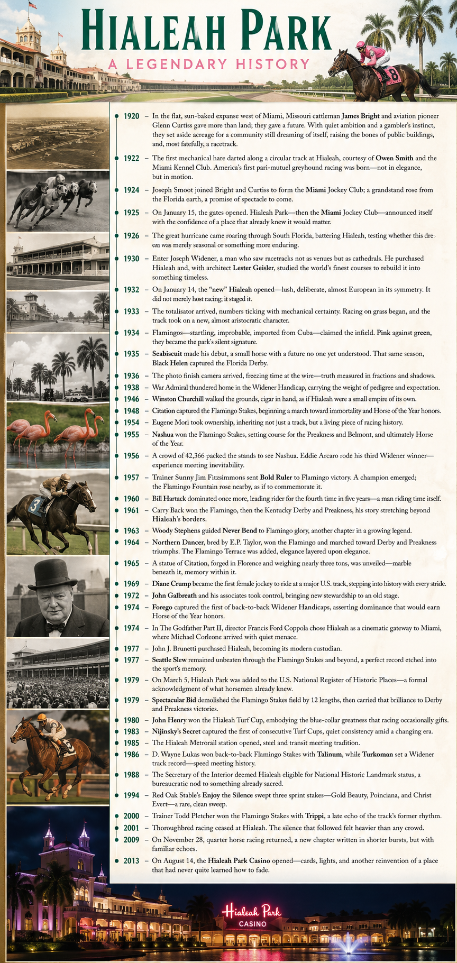
1920 — In the flat, sun-baked expanse west of Miami, James Bright and Glenn Curtiss gave more than land; they gave a future. With quiet ambition and a gambler’s instinct, they set aside acreage for a community still dreaming of itself, raising the bones of public buildings and, most fatefully, a racetrack.
1922 — The first mechanical hare darted along a circular track at Hialeah, courtesy of Owen Smith and the Miami Kennel Club. America’s first pari-mutuel greyhound racing was born—not in elegance, but in motion.
1924 — Joseph Smoot joined Bright and Curtiss to form the Miami Jockey Club; a grandstand rose from the Florida earth, a promise of spectacle to come.
1925 — On January 15, the gates opened. Hialeah Park—then the Miami Jockey Club—announced itself with the confidence of a place that already knew it would matter.
1926 — The great hurricane came roaring through South Florida, battering Hialeah, testing whether this dream was merely seasonal or something more enduring.
1930 — Enter Joseph Widener, a man who saw racetracks not as venues but as cathedrals. He purchased Hialeah and, with architect Lester Geisler, studied the world’s finest courses to rebuild it into something timeless.
1932 — On January 14, the “new” Hialeah opened—lush, deliberate, almost European in its symmetry. It did not merely host racing; it staged it.
1933 — The totalisator arrived, numbers ticking with mechanical certainty. Racing on grass began, and the track took on a new, almost aristocratic character.
1934 — Flamingos—startling, improbable, imported from Cuba—claimed the infield. Pink against green, they became the park’s silent signature.
1935 — Seabiscuit made his debut, a small horse with a future no one yet understood. That same season, Black Helen captured the Florida Derby.
1936 — The photo finish camera arrived, freezing time at the wire—truth measured in fractions and shadows.
1938 — War Admiral thundered home in the Widener Handicap, carrying the weight of pedigree and expectation.
1946 — Winston Churchill walked the grounds, cigar in hand, as if Hialeah were a small empire of its own.
1948 — Citation captured the Flamingo Stakes, beginning a march toward immortality and Horse of the Year honors.
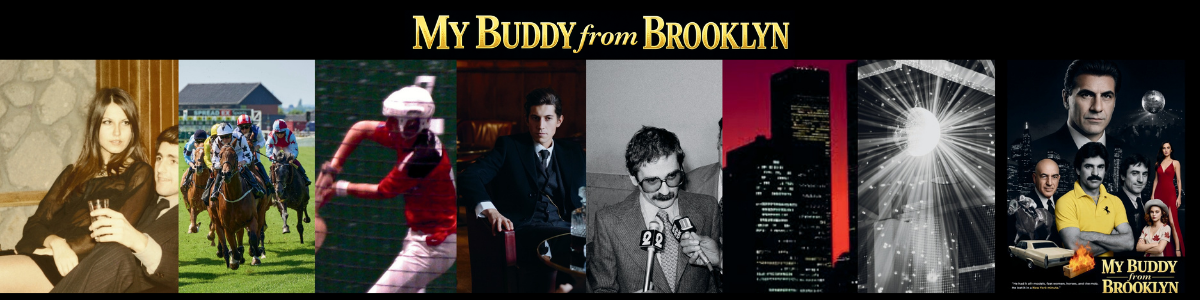
1949 — December. Buddy Jacobson's Uncle Gene Jacobs had Buddy Jacobson tell his parents he would study in Hialeah, Florida; the real intention was to race horses.
1954 — Eugene Mori took ownership, inheriting not just a track, but a living piece of racing history.
1955 — Nashua won the Flamingo Stakes, setting course for the Preakness and Belmont, and ultimately Horse of the Year.
1956 — A crowd of 42,366 packed the stands to see Nashua. Eddie Arcaro rode his third Widener winner—experience meeting inevitability.
1957 — Trainer Sunny Jim Fitzsimmons sent Bold Ruler to Flamingo victory. A champion emerged; the Flamingo Fountain rose nearby, as if to commemorate it.
1960 — Bill Hartack dominated once more, leading rider for the fourth time in five years—a man riding time itself.
1961 — Carry Back won the Flamingo, then the Kentucky Derby and Preakness, his story stretching beyond Hialeah’s borders.
1963 — Woody Stephens guided Never Bend to Flamingo glory, another chapter in a growing legend.
1964 — Northern Dancer, bred by E.P. Taylor, won the Flamingo and marched toward Derby and Preakness triumphs. The Flamingo Terrace was added, elegance layered upon elegance.
1965 — A statue of Citation, forged in Florence and weighing nearly three tons, was unveiled—marble beneath it, memory within it.
1969 — Diane Crump became the first female jockey to ride at a major U.S. track, stepping into history with every stride.
1972 — John Galbreath and his associates took control, bringing new stewardship to an old stage.
1974 — Forego captured the first of back-to-back Widener Handicaps, asserting dominance that would earn Horse of the Year honors.
1974 — In The Godfather Part II, director Francis Ford Coppola chose Hialeah as a cinematic gateway to Miami, where Michael Corleone arrived with quiet menace.
1977 — John J. Brunetti purchased Hialeah, becoming its modern custodian.
1977 — Seattle Slew remained unbeaten through the Flamingo Stakes and beyond, a perfect record etched into the sport’s memory.
1979 — On March 5, Hialeah Park was added to the U.S. National Register of Historic Places—a formal acknowledgment of what horsemen already knew.
1979 — Spectacular Bid demolished the Flamingo Stakes field by 12 lengths, then carried that brilliance to Derby and Preakness victories.
1980 — John Henry won the Hialeah Turf Cup, embodying the blue-collar greatness that racing occasionally gifts.
1983 — Nijinsky's Secret captured the first of consecutive Turf Cups, quiet consistency amid a changing era.
1985 — The Hialeah Metrorail station opened, steel and transit meeting tradition.
1986 — D. Wayne Lukas won back-to-back Flamingo Stakes with Talinum, while Turkoman set a Widener track record—speed meeting history.
1988 — The Secretary of the Interior deemed Hialeah eligible for National Historic Landmark status, a bureaucratic nod to something already sacred.
1994 — Red Oak Stable’s Enjoy the Silence swept three sprint stakes—Gold Beauty, Poinciana, and Christ Evert—a rare, clean sweep.
2000 — Trainer Todd Pletcher won the Flamingo Stakes with Trippi, a late echo of the track’s former rhythm.
2001 — Thoroughbred racing ceased at Hialeah. The silence that followed felt heavier than any crowd.
2009 — On November 28, quarter horse racing returned, a new chapter written in shorter bursts, but with familiar echoes.
2013 — On August 14, the Hialeah Park Casino opened—cards, lights, and another reinvention of a place that had never quite learned how to fade.